

Every vacant unit costs you money. In Louisiana's competitive multifamily market, the difference between a 30-day vacancy and a 10-day vacancy often comes down to how well your turnover process is designed. Most property managers treat turnovers as a necessary chore, a checklist of cleaning and patch repairs before handing over keys. That mindset leaves serious money on the table. A well-executed turnover is actually a strategic tool that directly impacts your occupancy rates, your reputation, and how long tenants choose to stay. This guide walks you through the full picture: what turnovers really involve, how to streamline them, why documentation matters, and how the process connects to tenant retention.
Table of Contents
- What property turnovers really involve
- Key strategies for efficient turnovers
- Documentation, compliance, and protecting your assets
- Retaining great tenants and improving satisfaction
- What most turnover guides get wrong
- Partner with experts for seamless turnovers
- Frequently asked questions
Key Takeaways
| Point | Details |
|---|---|
| Efficient turnovers boost occupancy | A well-structured turnover process quickly fills vacancies and sustains rental income. |
| Standardization prevents mistakes | Using checklists and vendor lists ensures every step is done right, every time. |
| Documentation protects managers | Photo records and detailed notes reduce disputes and improve compliance. |
| Retention outperforms replacement | Tenant satisfaction and follow-up lead to longer stays and positive referrals. |
What property turnovers really involve
A turnover is not just a cleaning appointment. It is a coordinated sequence of tasks that determines whether your next tenant moves into a unit they love or one that breeds complaints from day one. Property managers who treat turnovers as purely cosmetic work consistently struggle with longer vacancies and higher maintenance callbacks.
A full turnover process covers five core responsibilities:
- Move-out inspection — Walk the unit with a checklist immediately after the previous tenant leaves. Note every damaged item, missing fixture, and area of concern with timestamped photos.
- Repairs and maintenance — Address structural, mechanical, and cosmetic issues in priority order. Safety and habitability come first, always.
- Deep cleaning — This goes beyond surface wipe-downs. Appliances, grout lines, baseboards, and HVAC vents all need attention before a new tenant arrives.
- Documentation and record-keeping — Capture before-and-after photos for every repair and cleaning task. These records protect you in disputes and support future maintenance planning.
- Final walk-through and sign-off — Confirm the unit meets your standards before marketing it as available.
In Louisiana, habitability standards are not optional. State law requires rental units to be fit for human habitation, which means working plumbing, electrical systems, and structural integrity are legal requirements, not just good practice. Local codes in Baton Rouge and surrounding parishes can add additional requirements around moisture control and weatherproofing, given the region's climate.
"Overlap phases (market during repairs), standardize checklists and vendor lists, document with photos, and prioritize safety and habitability repairs."
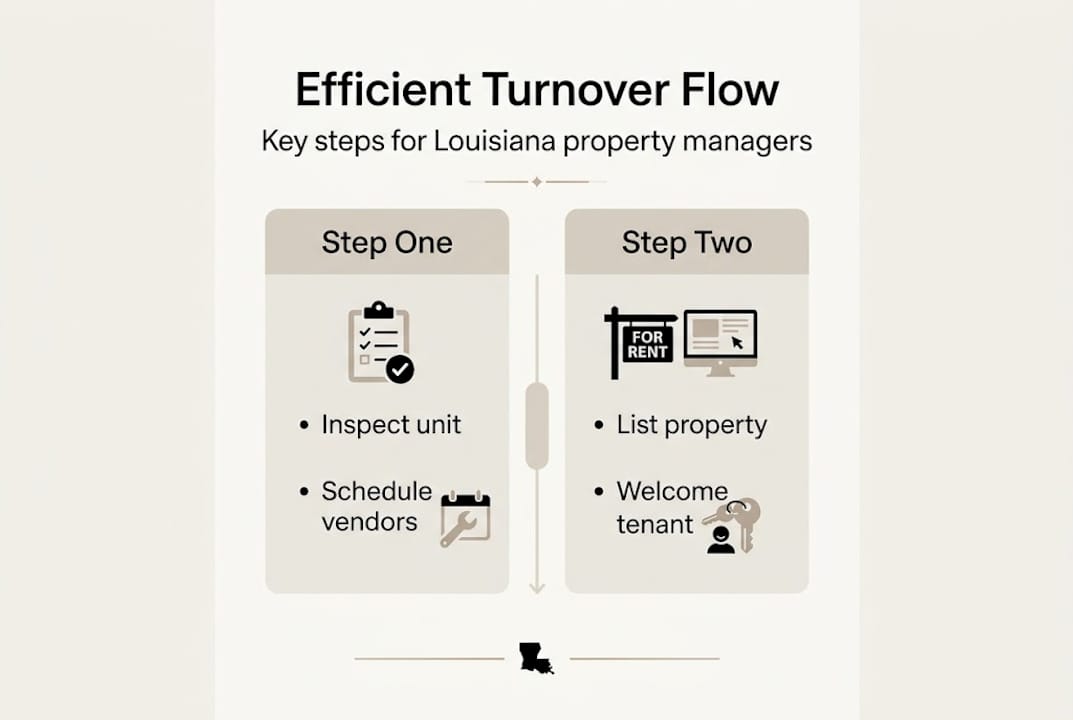
Thinking about your turnover services overview as a structured pipeline rather than a loose to-do list changes how fast you can move. When each step is defined, assigned, and tracked, nothing slips through the cracks. Review the turnover process details to see how a professional workflow maps to real multifamily properties.
Key strategies for efficient turnovers
Knowing what needs to happen is one thing. Executing it quickly and consistently is another. The property managers who keep vacancy periods short are not working harder. They are working smarter by building systems that remove guesswork.
Overlap your phases. The single biggest time-saver in any turnover is starting your marketing before repairs are complete. Take photos of comparable units or use virtual staging while the unit is still being worked on. Post your listing, screen applicants, and have a lease ready to sign the moment the unit passes final inspection. This overlap alone can cut vacancy time by several days.
Standardize your checklists and vendor lists. Every unit in your portfolio should go through the same documented process. Standardized checklists and vendor lists reduce errors and ensure nothing is skipped because someone assumed another team member handled it. When your preferred vendors know exactly what you expect, they deliver faster and more consistently.
Build and protect vendor relationships. A reliable painter, a responsive cleaning crew, and a trusted repair technician are worth more than any app or software. Treat these relationships like business partnerships. Pay on time, communicate clearly, and give them enough lead time to schedule your work as a priority.

Here is a quick comparison of how ad hoc turnovers stack up against a standardized approach:
| Factor | Ad hoc approach | Standardized approach |
|---|---|---|
| Average vacancy duration | 18 to 25 days | 8 to 14 days |
| Error rate per turnover | High | Low |
| Vendor response time | Inconsistent | Reliable |
| Documentation quality | Incomplete | Consistent |
| Tenant satisfaction on move-in | Variable | Consistently higher |
Pro Tip: Keep a digital photo library organized by unit number and turnover date. Before-and-after images from every turnover make it easy to spot recurring issues, justify security deposit deductions, and train new team members on your quality standards.
Explore maintenance and repair strategies that work for multifamily properties, and check out New Orleans turnover best practices if you manage properties across multiple Louisiana markets.
Documentation, compliance, and protecting your assets
Once your process is streamlined, the next crucial layer is safeguarding your properties and operations through careful record-keeping and adherence to regulations. Documentation is not paperwork for its own sake. It is your legal protection, your quality control system, and your institutional memory.
Here is what you should document at every stage of a turnover:
- Move-out inspection: Written notes and photos of every room, appliance, and fixture. Include the date, unit number, and the name of the person conducting the inspection.
- Repairs completed: Work orders with dates, descriptions, vendor names, and costs. Attach photos showing the condition before and after each repair.
- Cleaning completion: A signed checklist confirming each cleaning task was performed, ideally with photos of key areas like kitchens and bathrooms.
- Final walk-through: A second set of photos and a sign-off form confirming the unit is rent-ready.
The table below shows common documentation items and why they matter:
| Documentation item | Primary use |
|---|---|
| Move-out photos | Security deposit dispute resolution |
| Repair work orders | Liability protection and cost tracking |
| Cleaning checklists | Quality control and vendor accountability |
| Final walk-through report | Lease-ready confirmation and legal compliance |
| Vendor invoices | Financial records and tax documentation |
Louisiana landlord-tenant law gives tenants the right to dispute security deposit deductions. Without timestamped photo documentation, you are arguing your case without evidence. Courts consistently side with whoever has the better paper trail.
Local compliance in Baton Rouge also means staying current on building codes related to electrical safety, plumbing, and mold remediation. Louisiana's humidity creates conditions where moisture issues can escalate quickly. Catching and documenting these during a turnover is far cheaper than addressing them after a new tenant moves in and files a complaint.
Access turnover compliance resources to make sure your documentation process meets both state and local requirements.
Retaining great tenants and improving satisfaction
Managing turnovers doesn't just end with handing over the keys. It opens the door to enhanced tenant relationships. The quality of your turnover directly shapes a new tenant's first impression, and first impressions in rental housing are sticky. A tenant who moves into a spotless, well-repaired unit starts their lease with confidence in your management. That confidence translates into renewals.
Here is a simple four-step process for using turnovers to boost retention:
- Deliver a move-in ready unit. Every item on your checklist should be complete before the tenant's first day. Nothing signals poor management faster than a tenant discovering broken fixtures or dirty appliances on move-in day.
- Send a welcome communication. A brief email or handwritten note with emergency contact information, trash pickup schedules, and a genuine welcome sets a positive tone immediately.
- Conduct a 30-day check-in. Call or email the tenant one month after move-in to ask how everything is going. This shows you care and catches small issues before they become complaints.
- Use satisfaction surveys. Short, simple surveys after move-in and at lease renewal give you actionable data. Retention via satisfaction surveys consistently outperforms simply replacing departing tenants in terms of long-term profitability.
Pro Tip: A small welcome gift, such as a gift card to a local Baton Rouge restaurant or a basic household kit with light bulbs and batteries, costs very little but creates a memorable move-in experience that tenants talk about to friends and family.
Tenant referrals are one of the most underrated benefits of a strong turnover process. When residents feel well cared for from day one, they recommend your property to people they know. That word-of-mouth pipeline reduces your marketing costs and brings in higher-quality applicants. Review turnover steps for landlords and explore how Baton Rouge tenant retention strategies can be built directly into your turnover workflow.
What most turnover guides get wrong
Most turnover guides hand you a checklist and call it a day. The checklist matters, but it is not the whole story. In Louisiana's multifamily market, timing and communication are just as critical as the tasks themselves. A perfectly completed checklist delivered three weeks late still costs you thousands in lost rent.
Here is the uncomfortable truth: many property managers chase speed at the expense of quality. Rushing a paint job or skipping a thorough inspection to hit an arbitrary move-in date creates callbacks, complaints, and early lease terminations. That is a false economy. A few extra days spent doing the job right saves you weeks of headaches later.
The other thing most guides overlook is the retention angle. Proactive move-in support and genuine follow-up consistently outperform the strategy of simply replacing tenants faster. The real cost of turnover is not just the repair bill. It is the lost rent, the marketing spend, the screening time, and the risk of placing a less qualified tenant under pressure. Closing that gap requires streamlining turnovers advice that goes beyond task lists and into relationship management.
Partner with experts for seamless turnovers
If the strategies in this article resonate with you, the next step is finding a partner who can help you execute them consistently across every unit and every cycle.

M & K Turnovers works directly with property managers and apartment communities throughout Baton Rouge and surrounding Louisiana markets. From turnover cleaning and interior painting to sheetrock repair and tub resurfacing, we handle the work that gets your units rent-ready fast without cutting corners. Our team understands the local market, the local codes, and the urgency that multifamily managers face. Explore property manager turnover solutions or review our complete turnover offerings to see how we can support your next vacancy cycle.
Frequently asked questions
What is the most important task during a property turnover?
Prioritizing safety and habitability repairs should come first, as these ensure legal compliance and protect both tenants and property owners from liability.
How do standardized checklists help property managers during turnovers?
Standardized checklists and vendor lists reduce errors, ensure every step is covered, and help your team move through turnovers faster and more consistently.
Why is tenant feedback important in the turnover process?
Collecting feedback through satisfaction surveys leads to higher retention rates because it shows tenants their experience matters, and retention via surveys consistently outperforms the cost of finding replacement tenants.
What documentation should property managers collect for turnovers?
Managers should document with photos at every stage, including move-out inspections, completed repairs, and final walk-throughs, with timestamped images and signed checklists to support any future disputes.